Second Annual Event Hosted by the Legal Writing Institute's AI Committee and University of Wisconsin Law School.
Join the Legal Writing Institute's AI Committee for a dynamic, one-day online event exploring the evolving role of generative AI in legal education and practice. This event offers a unique opportunity to connect with colleagues across the spectrum of experience—from early adopters to AI skeptics—who are ready to engage in thoughtful dialogue, collaborative exploration, and forward-thinking innovation.
This event is designed to spark conversation and community around AI’s implications for lawyering skills. Through solo presentations, panels, demonstrations, and discussion-based sessions, we’ll address timely topics such as:
- Teaching research, analysis, writing, and revising in the AI era
- Developing learning outcomes and assessments that reflect new capabilities
- Maintaining ethical and professional standards in a changing landscape
- Supporting access to justice through innovative technologies
- Collaborating with students, employers, and allied professionals
 Whether you're experimenting with ChatGPT in the classroom, rethinking your learning outcomes, or simply curious about what’s next, you're welcome here. We've intentionally kept the registration fee low to foster broad participation across the LWI community.
 Don't miss this chance to help shape the future of legal education and lawyering in the age of AI.
Register Now
Schedule for June 2, 2026
The schedule for this year's conference is below. All times are in Pacific Daylight Time.
Teaching with and About GenAI
8:00–9:30 a.m. PDTWelcome & Logistics (10 min.)
LWI AI Conference Committee members Margie Alsbrook, Rebekah Hanley, Desmund Wu
Room 1: 1L Focused
Don't Follow the Recipe Blindly: Teaching 1Ls Why Legal Expertise Matters in the Age of AI (20 min.)
Materials
Rough Around the Edges: How AI Works Like Common Law (20 min.)
Foundations Under Pressure: Legal Skills Pedagogy in a Rapidly Evolving AI Landscape (20 min.)
Marci A. Rosenthal & Yordanka V. Delionado
Why Cutting the Wi-Fi in 1L Legal Writing Builds More Resilient Law Students (20 min.)
Room 2: Upper-level Focused
Don't Ask, Do Tell: Teaching Disclosure Duties in the Age of Generative AI (20 min.)
Dyane L. O’Leary & Colin M. Black
Designing the Future: Teaching Law Students to Navigate And Shape the Business Model of Law Firms in the Age of AI (20 min.)
Prompting for Purpose: Using AI to Design Meaningful Exercises in Evidence and Beyond (20 min.)
Integrating AI into Transactional Legal Writing Courses: Insights and Opportunities (20 min.)
Materials
Building GenAI Skills
9:45–10:50 a.m. PDTRoom 1
No Coding Required: Using Generative AI to Transform a Static Document into an Interactive Web Tool (20 min.)
"Claude, Create a Teaching Assistant Skill" (20 min.)
Materials
Teaching Legal Writing in the Age of AI: Using Generative Tools to Build Skills Students Can't Outsource (20 min.)
Room 2
Orienting Students to AI Use in Law School: Tools, Ethics, and Professional Judgment (20 min.)
Materials
Creating and Using Customizable AI Assistants for Law Professors (45 min.)
Materials
GenAI Use Cases for Faculty
11:10 a.m.–12:20 p.m. PDTRoom 1
AI Fellows as Faculty Innovators: A Cross Disciplinary Approach (45 min.)
B. Afton Cavanaugh & Jessica Wherry
Use Generative AI to Assist You in Giving Student Feedback? Yes, If You Have Ethical Standards (20 min.)
Expediting Common Classroom Administrative Tasks with GenAI (5 min.)
Materials
Room 2
Partnering with AI: Practical Applications in Legal Writing Pedagogy and Empirical Scholarship (45 min.)
Materials
Generative AI as a Community-Building Tool? Leveraging Our AI Know-How to Create Leadership Opportunities and Foster Faculty Connections (20 min.)
AI in the Hiring Process (5 min.)
Works in Progress & Research
12:35–2:05 p.m. PDTRoom 1: Works in Progress
Misuse as Mirror: What AI Reveals About Lawyers, Law Students, and Wellbeing (45 min.)
Materials
Risk Management as a Lawyering Skill (45 min.)
Materials
Room 2: Research & Practice
Teaching Legal Research in the Age of AI: A Framework for Building AI-Literate, Practice-Ready Graduates (45 min.)
Materials
Teaching Generative AI in Legal Practice: What We Teach and What We’ve Learned (45 min.)
Yan Slavinskiy & Rebecca Delfino
Brief Closing Remarks (10 Min.)
2:05–2:15 p.m. PDT
Presenters
Learn more about the virtual conference presenters.
Jill Barton

Jill Barton is a professor and the Legal Writing Director at the University of Miami School of Law. She is the author of three books on legal writing, including The Supreme Guide to Writing, which draws on her five-year analysis of U.S. Supreme Court opinions. She is a former appellate judicial clerk and award-winning journalist.
Sydney Beckman

Professor Sydney Beckman is a distinguished legal scholar, educator, and institution builder specializing in Evidence law. He served as Founding Dean of the Lincoln Memorial University Duncan School of Law from and continues to teach Evidence, Advanced Evidence, Technology and the Law, Civil Procedure, and Public Speaking for Lawyers.
A nationally recognized expert on interactive teaching technology, Professor Beckman has delivered lectures at law schools and universities throughout the United States on effective methods for teaching, assessment, and student engagement.
Professor Beckman's extensive publication record includes six books on Evidence, a volume on Social Media evidence, and a co-authored work on Federal Testimonial Privileges. He is also the author of the Federal Trial Objections and Rules Quick Reference Card, now in its 5th Edition, and co-author of several state Quick Reference Objection Cards. His current projects include three new Evidence books, one of which gamifies the teaching of Evidence through interactive logic puzzles.
Before entering legal education, Professor Beckman was a partner at Goodman, Clark, and Beckman in Arlington, Texas, where he held Board Certification in Family Law, and served as Municipal Judge Pro Tem for the City of Fort Worth.
Beyond the classroom, Professor Beckman is an award-winning magician who has performed in four countries, holds a black belt in Tae Kwon Do, and is a proud father.
Colin M. Black

Colin M. Black is an Associate Professor of Legal Writing at Suffolk University Law School, where he teaches Legal Practice Skills, Professional Responsibility, and Generative AI and the Delivery of Legal Services. His scholarship focuses on professional identity formation, legal ethics, and the responsible integration of generative AI into law practice.
His most recent publications include "To Disclose or Not to Disclose the Use of Generative AI in Law Practice" in Proceedings and "On Becoming a Lawyer: Authentic Professional Identity Formation and the Future of Legal Education" in the St. Mary's Journal on Legal Malpractice & Ethics.
At Suffolk, Professor Black co-designed the first law school course on Generative AI and a subsequent experiential course covering ethical compliance, prompt design, research analytics, and practice management integration of AI tools. He has served on the Executive Committee of both the Legal Writing Institute and the AALS Section on Legal Writing, Reasoning, and Research.
Prior to joining the Suffolk Law faculty, Professor Black practiced for nearly two decades litigating complex business and employment disputes, and served as Associate Director of Advocacy Programs at Boston University School of Law. A U.S. Air Force veteran, he earned his J.D., cum laude, from Suffolk University Law School.
Jordan Burton

Jordan Burton teaches legal writing as a Visiting Assistant Clinical Professor at the Indiana University McKinney School of Law in Indianapolis. His forthcoming scholarship examines the clash of interests between families and the government within the child welfare system.
Before joining the faculty, Jordan was a public-interest litigator specializing in family law and child welfare. He represented private, non-profit, and government clients in roles at the Indiana Department of Child Services, Indiana Legal Services, and Kids’ Voice of Indiana.
B. Afton Cavanaugh

B. Afton Cavanaugh is an Assistant Professor of Law at the University of Baltimore School of Law. He previously served as a Service Professor of Law and Assistant Dean at St. Mary’s University School of Law, where he taught legal writing, bar preparation, and estate law and developed innovative curricula for online and in-person J.D. programs.
He is an AI Faculty Fellow Navigator for Spring 2026 and co-coordinated the 2023 conference Legal Education’s Next Generation: Embracing Online, ChatGPT, and Technology in Pedagogy and Practice. His work focuses on legal education innovation, estate law, and student success.
Jaclyn Celebrezze

Jaclyn Celebrezze is an Assistant Teaching Professor at the University of Washington School of Law. She regularly writes and presents on issues of hidden curriculum, emerging legal pedagogy, and professional development. Before beginning her teaching career six years ago, she practiced for several years in employment-based immigration law.
Sue Chesler

Sue Chesler is a Clinical Professor of Law and a Dean’s Fellow for Innovation at the Sandra Day O’Connor College of Law at Arizona State University. She teaches Legal Method and Writing, Legal Advocacy, and Contract Drafting and Negotiating. Her scholarship primarily focuses on transactional drafting and applied legal storytelling. She is the recipient of the 2020 Teresa G. Phelps Scholarship Award for Legal Communication, and regularly presents at national and international conferences about contract drafting, law school pedagogy, and the use of generative artificial intelligence in legal practice.
Leigh Coogan

Leigh Argentieri Coogan is a Visiting Professor of Legal Writing at the University of Pittsburgh School of Law. She is also the Co-Director of Externships. While teaching at Pitt Law, Professor Coogan and her colleague Ann Sinsheimer received a Personalized Education Grant from the University of Pittsburgh to evaluate law students’ mindsets and implement interventions to enhance their growth mindsets. Additionally, Professor Coogan organized a conference at Pitt Law for legal writing professors from across the globe. She has presented at various conferences, including LWI One-Day Workshops, and the University of Pittsburgh’s Assessment and Teaching Conference on cultivating resilience in students to become practice ready professionals.
Prior to teaching, Professor Coogan was an associate at K&L Gates, LLP. As an associate, she worked on a variety of matters in the areas of health care, construction, and white- collar criminal defense law. Her work included researching complex legal issues, negotiating with the federal government over discovery requests, and drafting various complaints and motions in both state and federal court.
Kirsten Davis

Kirsten K. Davis is a Professor of Law at Stetson University College of Law, where she recently completed a stint as the Provost's Faculty Fellow for Generative Artificial Intelligence and Higher Education. Holding a J.D., summa cum laude, from The Ohio State University and a Ph.D. in Human Communication from Arizona State University, her scholarship sits at the intersection of legal communication, rhetoric, ethics, and—most recently—generative AI. She founded and leads a national community of more than 550 law professors exploring GenAI's impact on legal writing, and her course "Legal Writing with Generative AI" was among the first offered to law students. Her essay "A New Parlor is Open" argues that GenAI marks a paradigm shift for the discipline. Her honors include the Legal Writing Institute's 2026 Mary S. Lawrence Innovation Award, the 2026 AALS Section on Legal Writing, Reasoning, and Research Award, the 2025 AALS Inaugural Technology Mentorship Award, and recognition on the ABA's 2024 Women of Legal Tech list.
Bryan Dearinger

Bryan Dearinger is an Associate Clinical Professor at the University of Oregon Law School in Eugene, Oregon. He teaches Legal Research and Writing I and II, Legal Profession (Ethics), Professional Sports Law, and In-House Counsel, among other courses. Before joining the faculty full time, he served the University as both an Associate General Counsel and an adjunct professor of law and, previously, as a civil litigator at the U.S. Department of Justice.
Erin K. DeBoer

Erin K. DeBoer serves as an assistant professor at Regent University School of Law, where she teaches various legal research and writing courses. In 2025, DeBoer became the director of the law school’s legal writing program.
DeBoer has a diverse background in academia, appellate law, and civil litigation. She twice served as law clerk to the Honorable S. Bernard Goodwyn in the Supreme Court of Virginia. DeBoer has also worked as an appellate attorney, primarily focused on civil appeals before the Supreme Court of Virginia and the Court of Appeals of Virginia.
Angela "Anna" Debush

Angela "Anna" B. Debush is an Assistant Professor of Legal Research & Writing at Chicago-Kent College of Law, where she teaches Remedies in addition to first-year legal research and writing courses. After graduating from the University of Chicago Law School, Anna started her career as an associate at Jenner & Block LLP. She then honed her research and writing skills by serving in various clerkship roles at the United States District Court for the Northern District of Illinois and the Seventh Circuit Court of Appeals. Most recently, Anna served as a career law clerk for Magistrate Judge Young B. Kim.
Rebecca A. Delfino

Rebecca A. Delfino is an Associate Professor of Law at LMU Loyola Law School (Los Angeles), where she teaches civil procedure, professional responsibility, appellate advocacy, and co-teaches a course on generative artificial intelligence in legal practice. Her scholarship examines the intersection of law, technology, and evidentiary integrity, with a particular focus on deepfakes and AI-generated evidence in judicial proceedings.
She is the author of leading articles on these topics—including Deepfakes on Trial and The Deepfake Defense—and her work has been cited by the Advisory Committee on Evidence Rules in shaping proposed reforms addressing AI evidence. In both her scholarship and teaching, Professor Delfino focuses on translating emerging technological risks into doctrinal and pedagogical frameworks for legal education. She is also the co-author of Principles of Appellate Advocacy (Wolters Kluwer, 3d ed. 2026), a widely adopted textbook.
Before entering academia full-time, she spent over two decades at the California Court of Appeal, where she worked on more than 1,000 appellate matters.
Yordanka V. Delionado

Professor Yordanka Delionado is the Associate Director of the Legal Skills & Values III (LSV III) Program and an Associate Professor at Florida International University College of Law. In addition to teaching LSV courses, she oversees the LSV III program’s day-to-today operations, supervises adjunct faculty, and collaborates with the LSV Director on curriculum development for LSV III, with a focus on advancing students’ legal writing and research skills.
Before joining FIU Law, Professor Delionado served as an Assistant U.S. Attorney for the Southern District of Florida and practiced commercial litigation, bringing significant real-world advocacy experience into the classroom.
An active member of the Association of Legal Writing Directors (ALWD), she serves on the ALWD Adjunct Programs Committee. She has presented at national and regional conferences, including those hosted by the Legal Writing Institute and the Southeastern Association of Law Schools, where she has addressed topics such as innovative approaches to teaching legal research, writing, and practice-ready skills and the evolving impact of artificial intelligence on the legal profession.
Lauren E. Diaz

Lauren E. Diaz, J.D., M.S.I., is a Reference, Instructional Services, and Technology Law Librarian, Technology and Innovation Fellow, and Adjunct Professor of Law at Nova Southeastern University Shepard Broad College of Law. She teaches legal research, created one of the first law school courses dedicated specifically to AI-assisted legal research, and is currently writing The AI Legal Researcher: Legal Research in the Age of Generative AI with Carolina Academic Press. Her teaching and scholarship focus on AI-assisted legal research, legal technology competence, and preparing practice-ready graduates for contemporary law practice. Her broader scholarship also explores intellectual property, social media, and emerging technologies, and her work has influenced both courts and academic discourse. Through her scholarship and public commentary, she continues to contribute meaningfully to national conversations on law, technology, and the evolving practice of law.
Ben Fernandez

Ben Fernandez teaches Legal Drafting, Legal Research and Writing and Pretrial Practice at the University of Florida Levin College of Law. He previously taught Legal Methods, Legal Research and Objective Writing, Lawyering Process for Litigation Practice, and Transactional Drafting at Florida Coastal School of Law.
Before that, he taught Legal Writing at Northeastern University School of Law in Boston, and Business Law at Cape Cod Community College. Ben has twenty-five years of experience practicing law in Massachusetts. He has an LL.M. in Financial Law from Boston University School of Law, as well as a J.D. from Northeastern University School of Law and a B.A. from Cornell University.
Kim Holst

Kimberly Holst is a Clinical Professor of Law and a Dean’s Fellow for Innovation at the Sandra Day O’Connor College of Law at Arizona State University. She has previously served as President of the Legal Writing Institute and as Chair of the Association of American Law Schools Section on Teaching Methods and the Section on Legal Writing, Reasoning, and Research. Professor Holst’s scholarship examines the intersection of law and media—particularly how media impacts public understanding of law or legal issues. Additionally, Professor Holst has presented to numerous domestic and international audiences about techniques for more effective law school pedagogy.
Kristin B. Gerdy Kyle
Kristin B. Gerdy Kyle is the H. Reese Hansen Professor of Law at the J. Reuben Clark Law School, Brigham Young University, where she teaches legal research and writing, advocacy, as well as scholarly and judicial writing, and directs the Rex E. Lee Advocacy Program.
A former Editor-in-Chief of Legal Writing: The Journal of the Legal Writing Institute and a longtime leader in national legal writing organizations, she has written extensively on legal pedagogy, rhetoric, and professional identity formation.
Her current work includes an empirical study of judicial voice and the integration of generative AI tools into legal writing pedagogy to enhance feedback, student engagement, and self-directed learning.
Martin McKown

Effective Fall 2025, Martin McKown will serve as an assistant professor at the Thomas R. Kline School of Law of Duquesne University. He teaches both foundational and elective courses, including Legal Research and Writing, Business Associations, Energy Regulation, and Privacy Law.
Before joining the full-time faculty, McKown taught for six years as a highly successful adjunct professor while simultaneously amassing a decade-long career in compliance and advisory roles. He has held high-impact positions in Fortune 500 companies and other major organizations, leading compliance transformations, developing policy frameworks, and ensuring regulatory adherence in highly regulated industries. His experience includes advising executive leadership, preparing reports for boards of directors, and working with regulators across state, federal, and international jurisdictions. His expertise spans strategic planning, risk management, and corporate governance.
McKown serves as a moot court coach and has led teams to success in national and international competitions, with teams earning top brief awards and advancing to final and semifinal rounds.
McKown also played a key role in the law school’s bar exam success, helping maintain its impressive pass rates by mentoring students as they prepare for the bar exam.In keeping with the Duquesne Kline School of Law teacher-scholar model, McKown is a committed scholar whose work has been published in the George Washington Law Review Arguendo, University of Florida Journal of Law and Public Policy, Mitchell Hamline Journal of Public Law and Policy, and Duquesne Law Review. Believing that legal knowledge should be accessible to all, he also compiled a free open-source casebook on energy regulation.
McKown earned his juris doctor from the Duquesne Kline School of Law, where he contributed to the Duquesne Law Review and the Appellate Moot Court Board. He also holds a master of business administration degree from Auburn University’s Harbert College of Business and a bachelor of science degree in political science from the University of Texas at Tyler.
Anna Morkos

Anna Morkos is an Associate Clinical Professor at Loyola Law School, Los Angeles. She teaches Legal Research & Writing and Contract Drafting. Prior to joining the Loyola faculty, she worked as in-house counsel for a multinational cosmetics company and, previously, as a civil litigator.
Chanal Neves-McCain
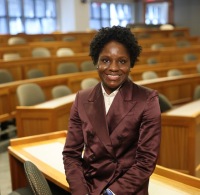
Chanal Neves-McCain, JD is an Assistant Professor of Legal Writing at Suffolk University Law school where she teaches in the Legal Practice Skills Program. Chanal’s scholarship and interests include professional identity development, access to justice, genAI in legal education, and professional responsibility.
Chanal previously practiced as an Assistant Attorney General specializing in constitutional and administrative law, data privacy and security, and civil rights. Chanal served as a Law Clerk to the Honorable Chief Justice Amy Blake of the Massachusetts Appeals Court, and as a Law Clerk to the Justices of the Massachusetts Probate and Family Court.
Dyane O’Leary

Professor Dyane O'Leary is a national leader at the intersection of legal writing and legal technology. She directs Suffolk's #1 nationally ranked LIT Center as well as the law school's LIT Concentration for JD students, which was included in Bloomberg's top 10 law school innovators list in 2023. Professor O'Leary is the author of the first student-centered coursebook on innovation and technology practical skills for lawyers. Her scholarship and speaking engagements focus on technology competence in legal practice and the law school curriculum. She has published and presented on topics such as Generative AI for lawyers, human connection as a lawyering skill amid technological change, and cybersecurity basics for lawyers.
At Suffolk Law, Professor O'Leary teaches the 1L Legal Practice Skills class, co-designed and taught the first course on Generative AI, and designed a new course called Modern Legal Practice Innovation & Tech, which covers skills in areas such as e-discovery, research analytics, and law practice management tools. She is former chair of the AALS Section on Technology, Law & Legal Education, a Fastcase 50 honoree, a member of the Hotshot Legal AI Advisory Board, and a past recipient of the ABA’s Women of Legal Tech distinction
Marci A. Rosenthal

Professor Rosenthal is the Director of the Legal Skills and Values Program and the Director of Institutional Effectiveness at Florida International University College of Law. She has taught at FIU since 2005 and has also taught legal writing at George Washington University Law School. Professor Rosenthal is an active member of multiple legal writing and other academic organizations and served for several years as the ALWD Co-Chair of the Joint LWI/ALWD Survey Committee.
Before moving into academia, Professor Rosenthal was a law clerk for the Honorable Jose A. Gonzalez, Jr., of the United States District Court for the Southern District of Florida, and then a litigation associate at McKenna & Cuneo (now Dentons) in Washington, D.C. She also worked at the United States Department of Education, Office of the General Counsel, where she specialized in administrative law, employment law, and issues related to the Family Educational Rights and Privacy Act.
While practicing in Washington, D.C., Professor Rosenthal worked with Project Citizenship, a pro bono program to assist elderly immigrants in obtaining citizenship. Professor Rosenthal also has served as an attorney for the School Board of Miami-Dade County. Over the course of her legal career, Professor Rosenthal has gained substantial pretrial and trial litigation experience before state and federal courts and administrative agencies. Her current research interests include the extent to which artificial intelligence can be used responsibly in effective legal writing.
Zachary Schmook

Zachary Schmook will be joining the University of Colorado Law School in Fall 2026. He was previously a professor of legal practice at the University of Oklahoma College of Law and an adjunct professor at Washington University School of Law. Prior to teaching full-time, he worked as an attorney at a St. Louis-based nonprofit dedicated to ending housing discrimination.
Katelin Shugart-Schmidt
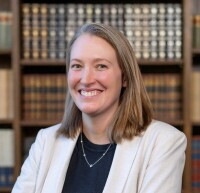
Katelin Shugart-Schmidt is an Assistant Professor of the Practice of Law at the University of Denver Sturm College of Law. She is a Fellow of the DU Center for Ethical Generative AI Applications (CEGAIA) and a Board Member of LWI Voices. Before joining the full-time faculty, she served as an appellate attorney for the U.S. Department of Justice, where she briefed and argued civil cases in the federal courts of appeals on administrative, constitutional, and environmental law issues. She previously taught as an Assistant Professorial Lecturer in Law at the George Washington University Law School and clerked on the Tenth Circuit.
Drew Simshaw

Professor Drew Simshaw specializes in legal technology, artificial intelligence, access to justice, and legal ethics. His scholarship addresses the ethical challenges of AI in law practice, emerging legal technologies, and the impact of these innovations on legal education and access to justice. His notable publications include the Fordham Law Review article, “Toward National Regulation of Legal Technology: A Path Forward for Access to Justice.” His book review, “The Legal Ethics of AI Snake Oil: Navigating the Hype, Harm, and Hope of Legal AI” is forthcoming in the Michigan Law Review.
Prior to joining Boyd Law, Professor Simshaw was an Assistant Professor at the Gonzaga University School of Law and a Visiting Associate Professor of Law, Legal Practice at Georgetown University Law Center. He also served as a supervising attorney at Georgetown’s Institute for Public Representation where he advocated for public-interest clients before federal agencies and appellate courts on communications and technology law issues. His work on behalf of individuals with disabilities earned him the 2017 H. Latham Breunig Humanitarian Award from Telecommunications for the Deaf and Hard of Hearing.
Professor Simshaw holds an LL.M. in Advocacy with distinction from Georgetown Law, a J.D. from Indiana University Maurer School of Law—where he served as Articles Editor for the Federal Communications Law Journal—and a B.A. from the University of Washington.
Yan Slavinskiy
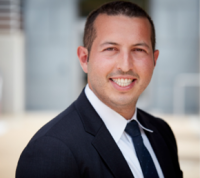
Yan Slavinskiy is an Associate Clinical Professor at LMU Loyola Law School (Los Angeles), where he teaches legal writing, ethical lawyering, and a course on incorporating generative artificial intelligence in legal practice. He is a co-author of Legal Method and Writing: Foundations for the Study of Law (10th Ed.)
Before joining Loyola’s faculty, he clerked for federal judges in the Southern District of New York and Central District of California and served as an assistant district attorney in the Appeals Division of the Manhattan District Attorney’s Office.
A first-generation college and law-school graduate raised with English as a second language, Professor Slavinskiy brings this perspective to his teaching and scholarship. He has presented at regional and national legal writing conferences on generational learning differences, generative artificial intelligence, and ways to address the law’s relationship to systemic inequality in the classroom.
Jessica Wherry

Professor Jessica Wherry is an Associate Professor of Law at the University of Baltimore School of Law, where she teaches legal analysis and writing and veterans law. Before joining UBalt in 2024, she taught legal research and writing at Georgetown University Law Center and previously held leadership roles in the legal writing program at The George Washington University Law School.
Professor Wherry served as assistant counsel in the U.S. Department of the Navy’s Office of the General Counsel, practicing federal procurement and employment law, and was an active-duty cryptologic technician in the U.S. Navy, including service in Yokosuka, Japan.
She holds degrees from Lawrence University, Syracuse University, and The George Washington University Law School, along with a certificate in Military & Veterans Health Policy and Advocacy from William & Mary Law School.
Her scholarship focuses on veterans and military law, legal communication, and generative AI, with publications in leading journals including the California Law Review and Legal Communication & Rhetoric. She also serves in leadership roles, including reporter for Maryland Pattern Jury Instructions–Civil and co-editor-in-chief of Legal Communication & Rhetoric: JALWD.
Kristen Wolff

Kristen Wolff is a clinical assistant professor at the University of Michigan Law School. She teaches and supervises students in the Zell Entrepreneurship Clinic, a pro bono law clinic providing transactional legal services to student entrepreneurs and local startups. Prior to joining the law faculty 5 years ago, Kristen practiced patent and trademark law in private practice and worked at the University of Michigan Office of Tech Transfer as associate director of licensing. Kristen’s research is directed to studying and removing barriers to entrepreneurship and exploring the future of legal education and work with the advent of GenAI.
LWI AI Conference Committee
Learn more about the conference host committee members.
Margie Alsbrook
 Margie Alsbrook is an Assistant Professor of Law at Mercer University School of Law, where she teaches legal writing, agricultural law and civil procedure. She holds a J.D. and an LL.M. (Master of Laws) in food and agricultural law from the University of Arkansas School of Law where she was the founding editor-in-chief of the Journal of Food Law & Policy.
Margie has over almost two decades of practice experience, and before joining the legal academy she worked on national food & agriculture policy issues for a hunger-awareness non-profit based in Washington, D.C.
She currently serves on the Board of Directors for Scribes: The American Association of Legal Writers and she also holds leadership and service positions in the Legal Writing Academy (LWI) including the subcommittee on artificial intelligence. Her academic scholarship has been published in the Arizona State Law Journal, the Georgetown Journal of Legal Ethics, the Arkansas Law Review, the Journal of Food Law & Policy, and the Drake Journal of Agricultural Law. Margie is also a former Justice of the Peace.
Rebekah Hanley
 Professor Rebekah Hanley is a long-time faculty member at the University of Oregon School of Law, where she teaches legal writing, professional responsibility, and a new course about generative artificial intelligence (AI) and the legal profession. Before joining the Oregon Law faculty she completed two clerkships, first for a judge in the Central District of California and later for a judge on the Ninth Circuit Court of Appeals. Between her two federal clerkships, Professor Hanley litigated with Munger, Tolles & Olson LLP in Los Angeles. Professor Hanley is Oregon Law’s current Galen Scholar in Legal Writing; in that capacity, she is studying generative AI and its implications for law school teaching and the practice of law. She co-chairs LWI’s new AI Committee and has written and spoken widely on generative AI.
Desmund Wu
 Desmund Wu teaches legal research and writing at the University of Wisconsin Law School. Professor Wu frequently presents on Generative AI, including conducting law firm trainings on generative AI, presenting continuing legal education programs in California and Wisconsin about the ethical use of generative AI, and presenting at legal conferences on how Generative AI is biased.
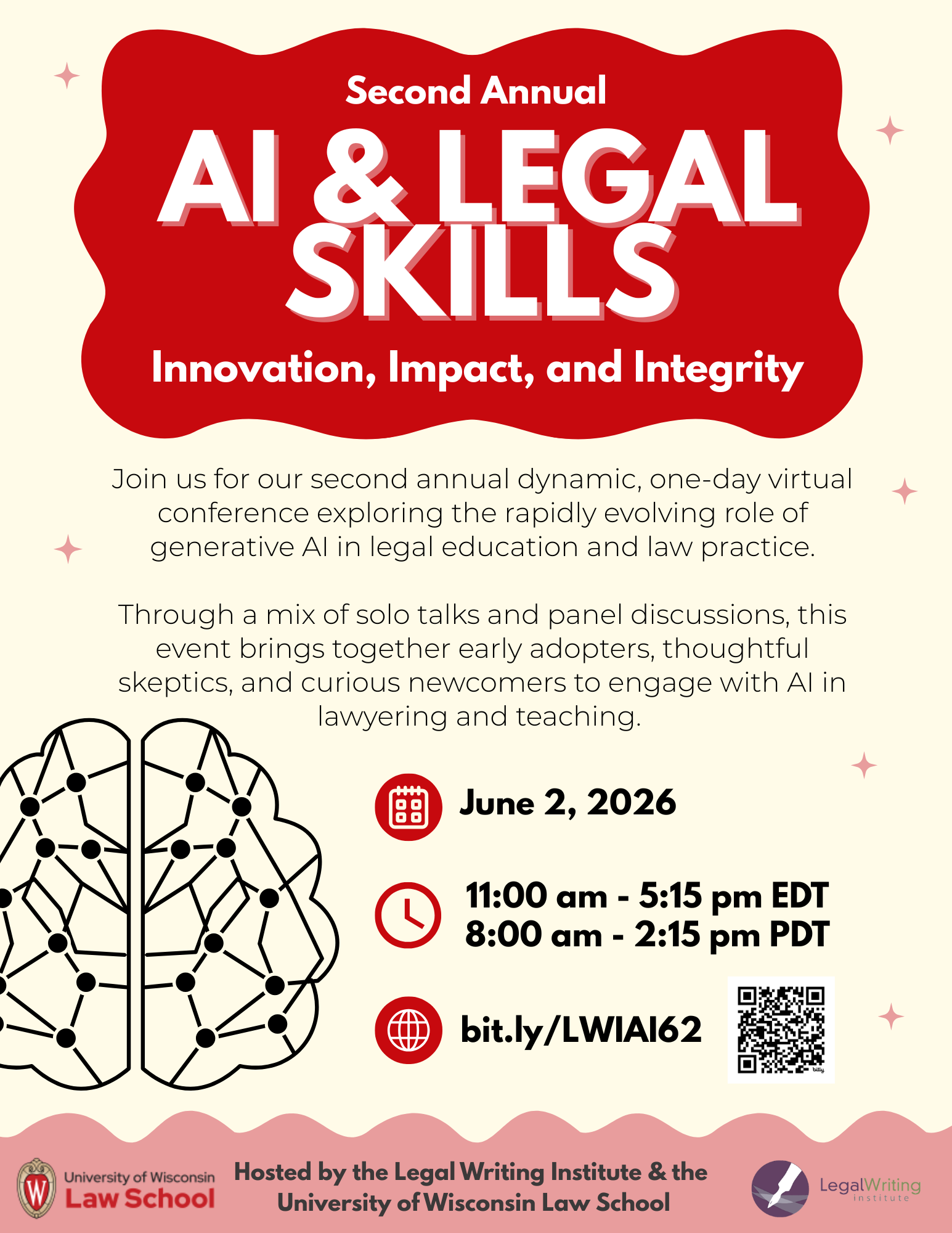
Event Flyer
Download the event flyer (PNG).
Previous Events
2025 Conference
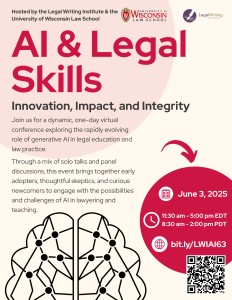
Hosted by the Legal Writing Institute’s AI Committee and the University of Wisconsin Law School
Join the Legal Writing Institute’s AI Committee for a dynamic, one-day online event exploring the evolving role of generative AI in legal education and practice. This event offers a unique opportunity to connect with colleagues across the spectrum of experience—from early adopters to AI skeptics—who are ready to engage in thoughtful dialogue, collaborative exploration, and forward-thinking innovation.
This event is designed to spark conversation and community around AI’s implications for lawyering skills. Through solo presentations, panels, demonstrations, and discussion-based sessions, we’ll address timely topics such as:
- Teaching research, analysis, writing, and revising in the AI era
- Developing learning outcomes and assessments that reflect new capabilities
- Maintaining ethical and professional standards in a changing landscape
- Supporting access to justice through innovative technologies
- Collaborating with students, employers, and allied professionals
 Whether you’re experimenting with ChatGPT in the classroom, rethinking your learning outcomes, or simply curious about what’s next, you’re welcome here. We’ve intentionally kept the registration fee low to foster broad participation across the LWI community.
 Don’t miss this chance to help shape the future of legal education and lawyering in the age of AI.
Schedule - June 3, 2025
The 2025 AI & Legal Skills Virtual Conference was held held on Tuesday, June 3, 2025. The current schedule is below.
10:30 a.m. CDT
(8:30 a.m. PDT)
Welcome
LWI AI Conference Committee members Margie Alsbrook, Rebekah Hanley, Desmund Wu (10 min.)
"Breaking the Pedagogical Paradigm: Transformative Approaches to Legal Writing in an AI-Centric Future"
Presenters: Kirsten Davis, Susan Tanner, Carolyn Williams (40 min.)
Moderator: Rebekah Hanley
10-Minute Break
11:30 a.m. CDT
(9:30 a.m. PDT)
Incorporating Student Reflections as Part of GAI-Assisted Legal Research and Writing Assignments
Presenter: Wendy Garewal (20 min.)
Materials: Documentation of Use of GAI Tool (PDF), Presentation Slides (PDF)
Mind the Gap: Creative Coherence in AI Generated Legal Writing
Presenter: Justin Kishbaugh (20 min.)
Using AI Thoughtfully in Legal Writing: Insights from the Classroom
Presenter: Alison Julien (20 min.)
Materials: PowerPoint Presentation (PPTX)
15-Minute Break
12:45 p.m. CDT
(10:45 a.m. PDT)
An Empirical Examination of Student Attitudes Toward Drafting with AI
Presenter: Abby Perdue (20 min.)
Looking Beyond Mata: Surveying Judicial Responses to Generative AI in Legal Practice
Presenter: Yan Slavinskiy (20 min.)
Materials: PowerPoint Presentation (PPTX)
No Need to Log in to Lexis or Westlaw? What General-Purpose Generative AI Tools Can Do Now for Anyone Including Student Legal Researchers and Legal CREAC Writers
Presenter: Bill Chin, Rob Truman (20 min.)
Materials: Prompt Document (DOCX), Presentation Slides (PDF), Presentation Slides (Google)
20-Minute Break
2:05 p.m. CDT
(12:05 p.m. PDT)
Navigating Bias in Generative AI
Presenter: Melissa Weresh (20 min.)
Teaching Hallucinations
Presenter: Jaclyn Celebrezze (5 min.)
How to Talk with Students You Suspect May Have Used AI Improperly
Presenter: Misti Duvall (20 min.)
Materials: Presentation Slides (PDF)
Beyond Briefs: Adding GenAI Assignments to Your Spring Persuasive Writing Problem
Presenter: Jonathan J. Sheffield (5 min.)
Materials: PowerPoint Presentation (PPTX)
15-Minute Break
3:10 p.m. CDT
(1:10 p.m. PDT)
Expanding the Scope: Exploring Topics in AI Scholarship and Legal Writing
Presenter: Kimberly Holst (5 min.)
Creating Attorney Advertisements: An Opportunity for Students to Use AI
Presenter: John Cook (5 min.)
Leveraging AI-Assisted Contract Drafting for Social Good
Presenter: Susan Chesler (20 min.)
Materials: PowerPoint Presentation (PPTX)
Teaching Students About the Use of AI for Interpretation/Translation Services in the Legal Setting
Presenter: Ericka Curran (5 min.)
Using AI to Prepare for Moot Court
Presenter: Jayne Woods (20 min.)
Materials: PowerPoint Presentation (PPTX)
4:05 p.m. CDT
(2:05 p.m. PDT)
Brief Closing Remarks
LWI AI Conference Committee members Margie Alsbrook, Rebekah Hanley, Desmund Wu (10 min.)
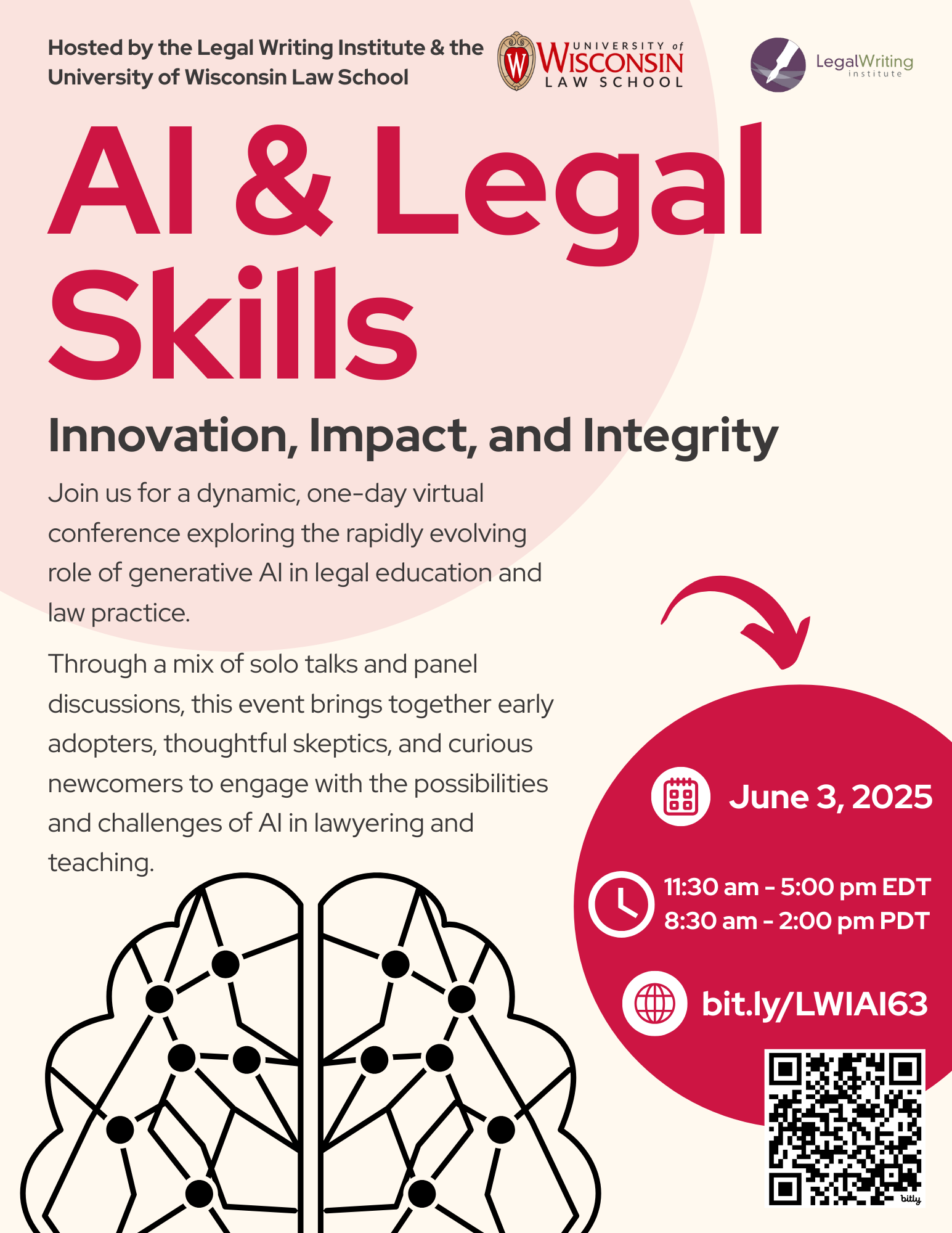
2025 Event Flyer
Download the 2025 event flyer (PNG).