The rich intellectual environment at University of Wisconsin Law School is driven by a faculty of renowned legal scholars and innovative thinkers. They are the thought provokers. The idea generators. The pathbreakers who ask tough questions.
This stellar scholarly tradition makes UW Law the vibrant institution it is today.
Read Our 2025 Brochure
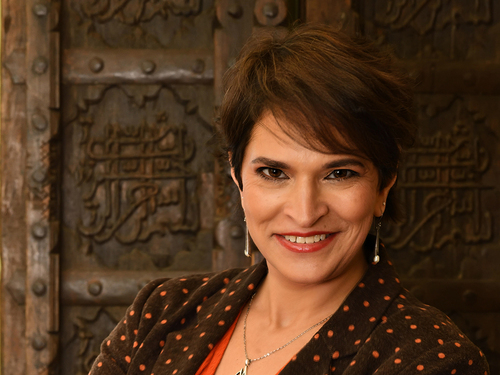
Tonya Brito Teaches Last Class at UW Law
On April 21, Tonya Brito wrapped up 29 years of valuable work at UW Law as a “mentor to generations” and a “voice for equity,” as Dean Dan Tokaji noted. Brito is the George H. Young Professor of Law and a faculty affiliate with the Institute for Research on Poverty (IRP) at the University of Wisconsin. She served as associate dean for research and faculty development from 2014-16 and as director of the Institute for Legal Studies from 2013-16. During her time as ILS director, she organized and hosted numerous academic conferences and speaker series, developed and inaugurated the ILS Law and Society Graduate Fellows Program and launched the Wednesday Workshop series, an internal works-in-progress series for law faculty. Brito’s research interests include access to civil justice, family law and policy, law and inequality, socio-legal studies and qualitative research methods. She is a national expert in the area of child support law and policy and has published widely in the area. She is a recipient of both University of Wisconsin-Madison’s 2012 Outstanding Women of Color in Education Award and University of Wisconsin System’s 2012 Outstanding Women of Color in Education Award.
Two New Innovative Courses Taught This Spring
Frank J. Remington Center Reentry and Outreach Support Specialist Dant’e Cottingham and Clinical Professor and Director of the Federal Appeals Project Adam Stevenson are co-teaching Criminal Justice System: A Lived Experience Perspective, aiming to provide students with a real understanding of the impact of incarceration, from arrest to life after release. Cottingham recently told public radio station WXPR, “My whole hope [with this class] is to connect [students’] learned experience with my lived experience and create something new, something more potent, something more powerful.” Cary Bloodworth is teaching “Sustained!” Wellness for Lawyers, covering topics such as perfectionism, trauma-informed and client-centered lawyering, self-care, time management, resilience, values and character exploration, anxiety and more. Visiting speakers such as Magistrate Judge Anita Boor and Wisconsin Supreme Court Chief Justice Jill Karofsky have shared their experiences and strategies for maintaining wellness in the profession. And students are completing a series of assignments throughout the semester, collectively forming a wellness toolbox they can use in practice.
UW Law Names Teachers of the Year for 2025 Instruction
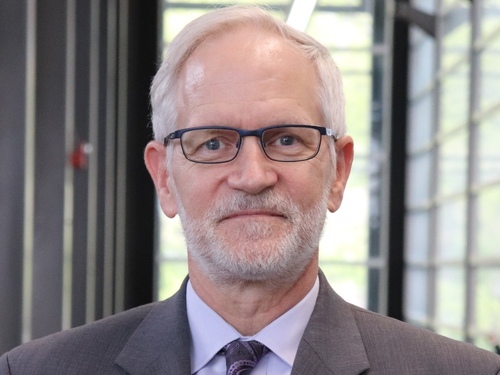
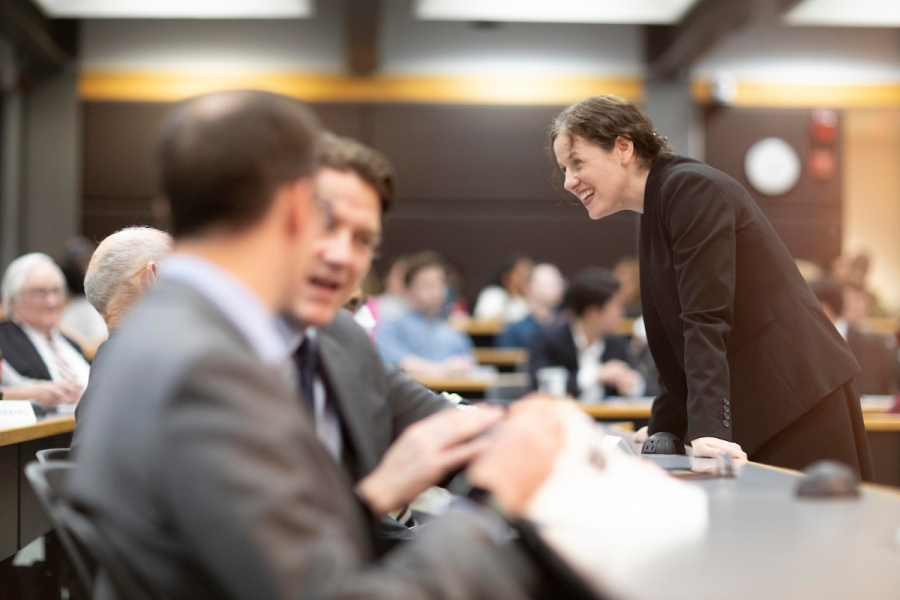
Each spring, University of Wisconsin Law School celebrates excellence in teaching through its Teacher of the Year awards. “One of the distinct pleasures I have as dean is working with some great faculty and seeing the transformative effect they have on our students,” said Dean Dan Tokaji during an awards ceremony in April. The honorees for outstanding classroom, clinical and adjunct instruction in 2025 include: Emily Cauble, Classroom Teacher of the Year: Emily Cauble is associate dean for Academic Affairs and Thomas G. Ragatz Professorship in Tax Law. Her research focuses on business taxation, tax administration and other aspects of tax policy. Ryan Poe-Gavlinski, Clinical Teacher of the Year: Ryan Poe-Gavlinski is director of the Economic Justice Institute, clinical associate professor, director of the Restraining Order and Survivor Advocacy Clinic and director of the Lawyering Skills Course at UW Law School. Nicholas J. McNamara, Adjunct Teacher of the Year: Judge Nicholas J. McNamara rejoined the UW Law adjunct faculty in 2020 to teach Evidence and present lectures in criminal procedure, advanced criminal practice seminars and clinical internship programs.
Anuj Desai Discusses Modern First Amendment Questions, Challenges
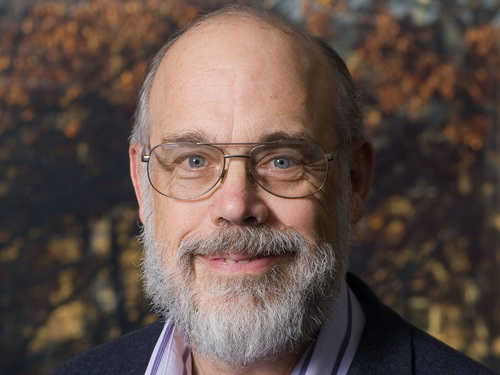
Anuj Desai, Volkman-Bascom Professor of Law, was featured on the latest episode of the Wisconsin Law in Action podcast. Desai discussed the nature of First Amendment law and its institutional contexts, explaining that free speech serves four core social values — truth-seeking, democracy, self-actualization and enabling peaceful social change — and that speech disputes are best understood within specific institutional settings, from the postal system and libraries to parks and universities. He introduced the key legal distinction between “speakers” and “conduits,” tracing it from historical examples like the post office and broadcast radio through to modern platforms. He also discussed contemporary challenges around social media and campus speech, highlighting the legal tension social media companies create by claiming conduit status under Section 230 while asserting speaker rights to resist regulation. Listen and follow on SoundCloud or Apple Podcasts.